Thursday, May 9, 2013

How to address anyone

When moving to any new place, it takes adjustment to grasp the social protocol for addressing people. First name basis? Last name basis? The intricacies of Miss and Ms., brother, sister? I wish I had more closely documented this phenomenon when I lived in other places, but then again, I never recall it being as complex as it is in Cambodia.

I've noticed that it's fairly rare to use someone's name when addressing them. I haven't found a convincing explanation for this. Instead, we use a complicated system of addressing each other based on each other's age relative to yours. You don't call Sue, "Sue," but maybe Bong or Ming, or Om. In a hierarchical culture, addressing other with the correct respectful term is important. It seems to effortless for Cambodians. For many foreigners when slapped with this system, it's slightly overwhelming. However, you too can get the hang of it and as a foreigner, your mistakes are more comical than offensive. 

  • PaOWN: This gender-neutral term is used to address children. If you see a child, call them this. Can be shortened to "own."
  • Bong: Use this with your contemporaries and it's considered gender neutral. Supposedly from women to men it's a term of endearment, but have observed otherwise. You can call the gas station attendant or you waiter/waitress bong.  If you are close with someone even when a five/seven year age gap, you would probably go with this term.
  • Ming: Woman "auntie" between 30-50ish? If you think you are younger than the woman, then go with this term.
  • Ome: Older auntie, as in your mother's contemporary. If I recall correctly, it's a term of endearment from a man to his wife (I don't know of one going the other way).
  • Puu: Uncle, for all men who are older than you and younger than your grandfather. At my partner organization, we call the director this term for additional respect.
  • Taa: Grandfather. Obvious.
  • YeyYey: Grandmother. Thankfully, also obvious.
  • Lookru: Respected male elder. When you want to be extra respectful, you go with this term instead of Puu or Taa

When translating these terms into English, my colleagues most often go with "brother" or "sister" which is interesting because those are two terms I don't think are used otherwise. However, it's source of personal joy when I'm called "Bong Grace" by my colleagues. It means I'm one of the guys.

Wednesday, May 1, 2013

How to Mix Wedding Cultures

A whole day of festivities

This isn't entirely my post to write. It's my friend Rach. She is the one who got married and the one who executed the social event of the season. But I loved it, and it was very Khmer (as is her husband) and very Aussie (as is she) at the same time and for that reason, I learned a lot.

Things I learned from this amazing experience.

  1. A wedding is an all day event. Started at 7am-noon and 5:30pm-10:30pm. 
  2. Allow people to go home and nap mid-day. A good wedding should have a nap.
  3. Serve breakfast and lunch and dinner at your wedding.
  4. Never drive a motobike in a silk skirt. It will wrinkle.
  5. Borrow said skirt and matching fancy top from a work colleague. Otherwise, you can buy one at the market pre-made for $35 or get one made for around $70.
  6. Have your guests wear traditional Khmer wedding attire for the morning ceremonies. 
  7. A fruit parade is a fabulous thing. Line up two-by-two with matching fruit platters behind the groom and his family and parade to the bride's family to whom the fruit is presented. If they like the gift of fruit (as thankfully, was the case), the wedding may proceed. 
  8. Have the parents follow a Khmer tradition of a tea ceremony, drinking tea together while surveying the fruit. Follow all this up with a Western-style ceremony.
  9. Have a duel language Western-style wedding service. Everything in English, and then in Khmer, and have it be effortlessly seamless. 
  10. Host a wedding in a context where all the women get their hair done professionally (and such a service costs $5) and naturally, everyone does, and that's just how it is. 
  11. As a guest, make two costume changes. If part of the wedding party, make three (actually four) changes. 
  12. Serve the tastiest Cambodian food of all time. 
  13. Dance to Khmer live Cambodia music. For a sample of this, check here. Have all your guests from Cambodia, Australia and everywhere else dancing enthusiastically for hours despite the April heat. 
  14. Include a champagne fountain.
  15. Don't get stressed about it. Don't obsess about all the details. Smile and go with the flow. This is a great life lesson.

Thursday, April 25, 2013

How to Visit Koh Mok

Thai Island Perfection

Khmer New Year is the epic holiday of Spring (or Hot Season, depending on where you are). Expat friends start asking what you're doing for the holidays starting end of February. Khmer colleagues head home to the province to spend time with family (KNY is like Christmas). This year I decided to go with Koh Mok (also known as Koh Mak), the result of extensive research; ie. google, TripAdvisor, texting.

Koh Mok is a Thai island of the coast of Thailand and Cambodia. Koh Mok is a quiet, seasonally populated report island that puts some effort into conservation. It attracts clientele a step-up from scuzzy youthful backpackers (there is also a ban on power water toys such as jet-skis).

To start the adventure, we departed at 6am from Phnom Penh in a hired car. We went southwest then northwest to Koh Kong in the Cambodian border with Thailand, arriving at approximately 11:30am. After an early lunch, we crossed the border on foot and got on a mini bus to Trat. This was approximately 70 minutes driving. From Trat, we got on a little renovated covered pick-up or "tuk truck" to make the ferry. This was where the fun began.
Traveling internationally [credit: google-maps]

Thailand and Cambodia share the same New Year (in addition to International New Year and possibly both celebrating Chinese New Year). In Thailand, the holiday is marked with a three day long water war. (Cambodia had the same custom until it was banned several years ago when idiots began substituting acid.) In Thailand, children and young adults drive around in pick up trucks with 50 gallon drums of water, throwing water at every passerby; cars, motorbikes, bikes, pedestrians, and especially other kids in pick-up trucks. This is often followed by throwing flour which sticks to everything wet. People set up drums outside their homes and also throw water at those passing by. This being Southeast Asia, people are wearing jeans, t-shirts, hoodies, and other water-heavy items of clothing. Many had water guns, clearly cherished for this beloved day. Sadly, for obvious reasons, I have no photos of this these event.

On our way from Trat in our "tuk truck," we had the misfortune traversing a road lined with kids in pick-up trucks. The trucks were moving at 2 kilometers an hour so the water throwing occurred in slow-motion with shrieks of delight. There might have been 60 trucks with kids crammed in the back. Beer and other beverages were flowing from nearby carts (the owners were soaked), and a fire hydrant must have been disabled for this event as it gushed unrestrained for happy youths to refill their drums. Needless to say, we crammed our bags into the cab of the "tuk truck" and resigned to the water and flour. Surely enough 15 minutes later, we were completely soaked.

Making it to the ferry, completely soaked but with our valuables dry, we climbed aboard a ferry for Koh Mok. It was a refurbished speedboat which sat 30 people. Our trip along the gulf passing other islands took about 50 minutes, after which we were deposited on a dock and the owner of our hotel picked us up in his beat-up little Datsan for the final two or three kilometers. By 4:30pm, we finally made it to our lovely little restort.

If you are going to travel so far and for so long and get so wet, you must stay for a while.

The holiday that followed really couldn't have brought any more enjoyment than the trip out. It was unseasonably wet and rained every single day. We ate so much Thai curry. In fact, I think I had curry four days in a row because Thai curry is unquestionably the best food in the entire world (please don't argue). We watched storms roll in and storms roll back out to sea, and in between laid on rafts floating off the coast in the relatively clean water. I read three books in our five days there, which might be a new record. We also played many board games, at many of which I triumphed, thankfully.

Some holidays you want adventure and new sights, (ie. Bali, Chiang Mai). Other holidays you just want to lay still and sleep. Sometimes you need quiet time to reflect, to reassess, to find healing and forgiveness, and feel overwhelming gratitude that you have the amazing opportunity to live in such a beautiful corner of the world. And the adventure getting out was certainly part of the joy! Going back into Cambodia, the immigration people harassed us looking for bribes (common at this specific border crossing) which bookend the travel adventures. However, the time at the beach was sheer perfection.

Friday, April 19, 2013

How I Learned Over Khmer New Year

Southwest Thailand.

Part of living in the Kingdom requires tumultuous ups and downs. Everyone does it. I seem to do it more than is necessary. Something about hot season makes thing the most difficult. 

Through my reading and my adventures, I started to reconnect with the idea of stories. I was a Lenten theme at my spiritual home. Our lives are stories. It's a cliche. Then I started to think about stories I've read or films I have seen recently...Les Miserables, Hunger Games, The Girl Who Kicked the Hornets Nest, Mamma Mia (the later one I'm not proud of). These are stories. Granted fiction (both Hunger Games and Mamma Mia could possibly happen in an post-apocalyptic distopian world) but these are stories. And I realized, as Donald Miller so eloquently pointed out in a recent book, stories and films illustrate life and things we experience. 


My time in Cambodia has been an interesting mix of ups and downs. There have been many difficult situations that never made sense. No one ever wants hard times. None of the characters in the stories and films I've seen intentionally sought pain or suffering. Life is messy. And though crap happens, we learn and grow because of it. We don't grow as sedentary objects. If our heroes and protagonists never put the TV remote down and went outside, there would be no story. We wouldn't watch their stories or cheer them on. We grow in motion, under pressure, in the moments as unexpected as our drives home or a lunch conversation. So while I didn't ask for the hard things that happened, like my fictional characters, I can embrace the challenge with dignity...or I can be pathetic. 

While I have six very full months left in the Kingdom, I've already begun to grieve a little; for the city that I've come to call home, for the friends who have built my world from mundane into hilarious and food-filled. I grieve for the freedoms I experience here (freedoms which ironically many are denied). I've realized the importance to continuing to rise to the challenge in these final six months. It's easy to coast to the end in a blanket of pity, denial and misguided nostalgia. Or it's the opportunity to put down the TV remote and go outside every single day looking for adventure, right to the end.

Six months. Carpe Diem. 

Thursday, April 11, 2013

This post is for the Year of the Dragon


Farewell Year of the Dragon. Thank you for being such a wonderful year for me. However, happy third and final New Year on the Cambodian calendar. Happy Khmer New Year! It's officially the Year of the Snake. I hate snakes. If I think about them too long I have nightmares the following even. I don't relate to the folklore of the Naga and I don't really understand why the zodiac couldn't have "year of the giraffe" or "year of the bird." However, I will accept the limitations of my cultural understanding in this regard. Happy Snakes people! It's a new year and we shall seize it with gratitude.

Despite the snake, despite my superstition about odd numbers, with joy and anticipation I look ahead to the this year. Where will I welcome the coming Year of the Horse? You and I will both discover. 

Thursday, April 4, 2013

How to Survive Hot Season 2013

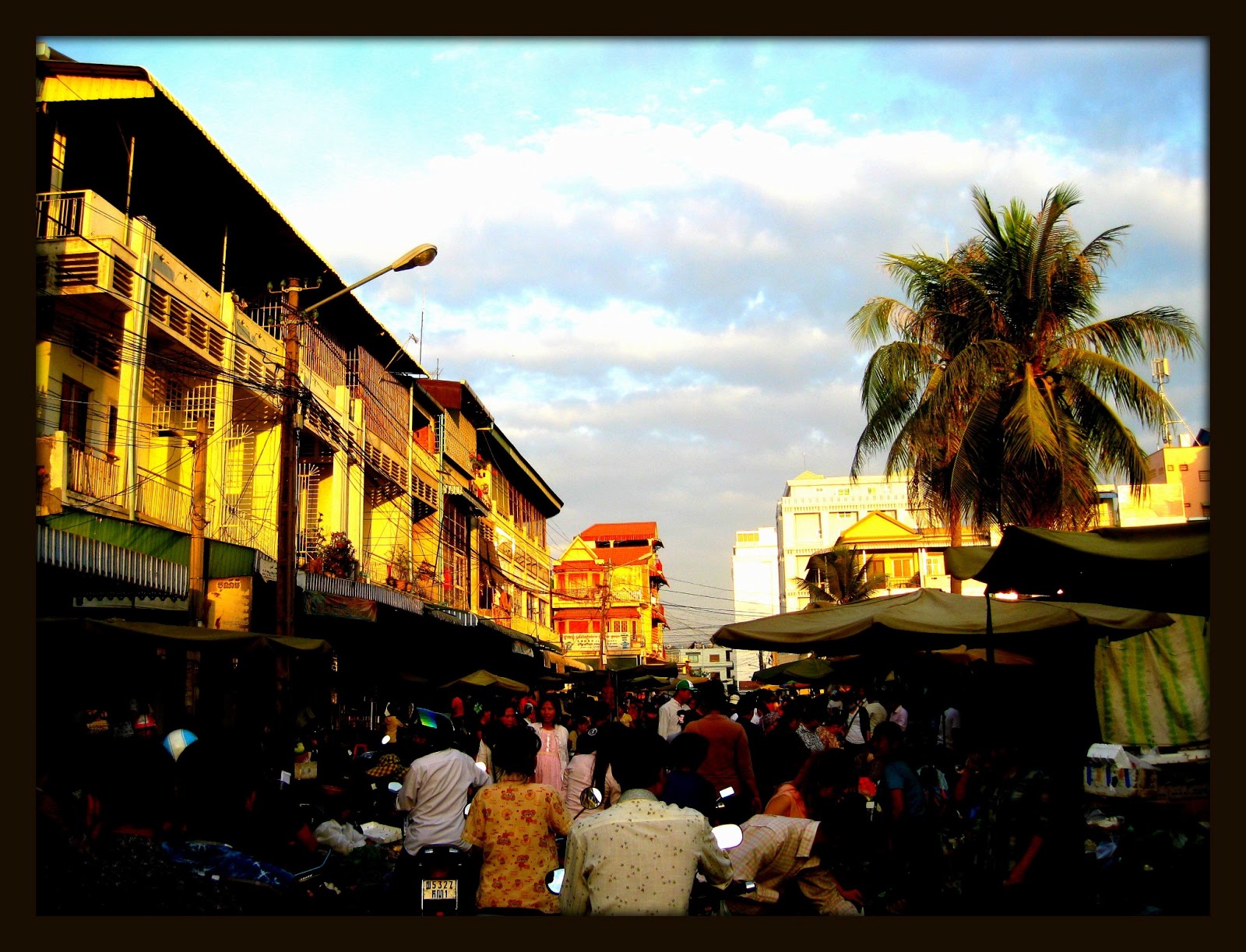
Though it is miserably hot, it's still busy at my local market in the Kingdom.

April is famous for being the worst month on the Cambodian calendar. 2013 ushered in what might win as the hottest of the three hot season I've experienced in the Kingdom. In fact, it's so hot that I'm starting to think in celsius. This means it's too hot. Starting about two weeks ago, we crossed into new levels of misery. We're current going at 31-33C with little sign of abating. I can't sugarcoat it. It's a terrible time of year and it could continue as late as June.

Prior to hot season, you work yourself up into a frenzy with fear of the heat. When it comes, it's basically what you expected. It's still awful, but it's rarely worse than you thought. Is the secret to surviving really managing expectations? I would hazard a yes.

Here are some of the strategies that I'm using this year:

  • Don't wear makeup. It's slides off.
  • Don't bother with your hair. It will only frizz.
  • Keep a fan on you at all time. 
  • Accept the sweat. Allow yourself to sweat constant.
  • Every hour, get a glass of water.
  • Wear a loose fitting shirt. 
  • Leave for work early. Bring your own lunch so you don't have to go out. Work at the same office all day so you can stay in AC.
  • Shower before work, when you return from work, when you go to bed. 
  • Midday trips home for a shower? Absolutely. An outfit change? Unquestionably.
  • No soup (if it can be helped)
  • Constantly ask your Khmer colleagues if it's hot. If they say yes, feel validated.
  • Own your misery. Don't pretend to be awesome. Don't be that person. 
We shall hope this season eases up. The saving grace is the AC in my bedroom. While I listen guilty to my colleagues as they confess they can't sleep in this awful heat, I'm thankful that I can sleep. In the end, it would be miserable for everyone if I didn't. None of us want that.

Wednesday, March 13, 2013

How to Survive a Wedding on your Street

We're getting married in the morning!
Deal with it.

Once upon a time, scarcely a month ago in fact, a wedding occurred on my street.

My sentiments regarding Khmer weddings has already been documented; Illogical public displays of nonexistent wealth in an effort to impress one's neighbors and community members. (Yes, I struggle with gross displays of nonexistent and legitimate wealth.) While I realize the average amount an American lays out for a wedding has recently peeked $27K (they are not immune to my immense judgement either), there are two things American weddings don't feature:

  1. Street blocking.
  2. Noise.

Street Blocking: I live on a narrow street [see above]. My street normally has cars parked on both sides and when this happens, it's a single lane road. It's very much a side street in a residential neighborhood and my neighbors are lovely and quiet.

However, for a wedding, you are allowed to pitch a tent that blocks the entire width of the road. If it's directly in front of someone's house..."Well that suck folks! Sorry! Guess you're not getting your car or your motobike out of your house! You can do the same to us when it's your turn but for now...sorry [not]." I become most frustrated with street blocking. While this wedding did not block my street, it did require me to zig-zag across my neighborhood to enter my street from the side that wasn't blocked. Not only is street blocking a complete and utter safety hazard, I find it stunningly rude from my cultural perspective but oddly it's not so here.

Noise: A sound system blasting at 5am when your wedding starts and finishing at 11pm when your wedding ends during which your entire building vibrates from the noise? Sorry, but I can't really even begin to make that sounds positive. The good news is that if you have friends, you can spend the night with them which is what I did and for this I'm very thankful. Again, how is this not considered rude? I will never understand.

For all of weddings loathsomeness, I will say this: the tent is down and the rubbish is cleared that very night. On this point, we can agree from a Cambodian and American perspective that this is only common courtesy.